

Quick Bits…
The recovery from fluid loss and dehydration can be hastened when associated symptoms are matched to a useful remedy.
t

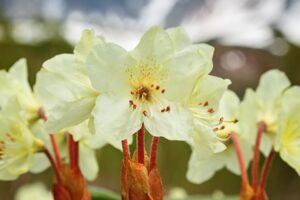
Common Names: Siberian rhododendron; golden flowered rhododendron; rhododendron aureum.
Rhododendron Chrysanthum (Rhod.) is a one of the remedies for rheumatic and neuralgic pains, especially of the joints. Those needing Rhod. are sensitive to barometric changes and can foretell the approach of a thunderstorm. Any sort of symptom may start or worsen before a thunderstorm – headache, pain, cough, diarrhoea, etc. – causing the sufferer to be anxious with the approach of a storm, even to the point of fear. Symptoms also worsen with wind or cold, wet weather but improve with warmth and gentle ongoing motion. The male gonads may also be affected with orchitis or epididymitis being common problems. Two unusual symptoms that may be experienced are that the person will only be able to sleep if their legs are crossed at the ankles, and the sensation of water being dashed against inner parts may occur.
Rhododendron Chrysanthum (Rhod.) is available from our online store as a single remedy in either pills or liquid and as part of the following Complex (combination remedy): Joints – Stiff.
Conditions like colds or minor injuries, which are short-term and typically improve on their own, can be managed at home with homeopathy. However, in emergencies or if symptoms worsen, contact your healthcare provider.
These home treatment instructions do not apply for ongoing issues, whether mentioned above or not, like persistent allergies or chronic pain. You should consult a qualified homeopath for a personalized treatment plan to achieve the best results with homeopathy for chronic conditions.
Homeopathy is a 200-year-old system of medicine. Early homeopaths recorded detailed notes on how remedies worked, including initial tests, remedy relationships, and their experiences. These writings were shared to improve homeopathic practice and now offer fascinating insights into past uses of homeopathy. Here’s an example, edited and modernised for clarity, from Leaders In Homoeopathic Therapeutics (1898) by E. B. NASH M.D.:
Will naturally come in for notice while we are upon weather remedies. Like Dulcamara, its strongest characteristic is in its modality, “aggravation in wet stormy weather;” but Rhododendron is particularly worse before the storm, especially a thunder storm; after the storm breaks the patient feels better.
The aggravation before the thunder storm does not at all seem to depend on the coldness or dampness, but partially at least on the electric conditions of the atmosphere. This is like Phosphorus, Natrum carb. and Silicea. Rhododendron resembles Rhus toxicod. in that it is worse during rest and better during motion.
Again, the pains of Rhododendron, which are aggravated in damp weather, differ from those of Rhus toxicod. in that they seem to be deeper seated and are felt in the periosteum, as in the teeth, and in the bones of the forearm and tibia. These pains are not, however, confined to periosteal membranes, but attack also muscles and ligaments, so as to make it difficult to choose between these remedies.
So we have quite a list of marked wet weather remedies in Dulcamara, Natrum sulphuricum, Rhododendron, Rhus toxicodendron and Nux moschata. (Calcarea phosphorica, wet cold, especially melting snow).
Rhododendron seems to have an especial affinity for the testicles. They are swollen, with drawing contusive pains, which sometimes extend to abdomen and thighs, and they are very sensitive to touch.
The remedies most like it are Aurum metall., Clematis erecta, Pulsatilla, Argentum metall., and Spongia.
If the affection was of syphilitic origin we would prefer Aurum, especially if the case had been abused by old school mercurialization. If it came from suppressed gonorrhoea, Clematis or Pulsatilla; if of rheumatic origin, Rhododendron.
Of course all the case would come into the calculation when making up the perfect picture.
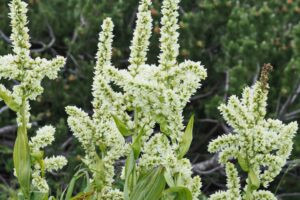
Common Name: White hellebore, European white hellebore, false helleborine.
Veratrum Album (Verat.) is easily recognised by its pronounced mental-emotional state or intense physical symptoms. Those who do well with Veratrum are excessively ambitious, haughty, and generally unconcerned about the effect of their behaviours and attitude on others. Their mental restlessness can lead to mania or delusions of grandeur. On the physical level, Veratrum is a remedy for severe or simultaneous vomiting and diarrhoea, cramps and spasms, profuse cold sweat, and weakness or collapse. Historically, it was used for cholera as a treatment or preventative when those symptoms were present. With or without physical symptoms, those needing Veratrum may complain about chilliness and crave sour flavours, salty things, cold drinks or ice. Children needing Veratrum tend to be restless, precocious (advanced for age), curious or questioning. Easy frustration leads to repetitive behaviours such as nail-biting, stacking, cutting or tearing, and disobedience or behavioural problems with a lack of remorse.
Veratrum Album (Verat.) is available from our online store as a single remedy, and as part of the following Complexes (combination remedies): Food Poisoning; Nail Biting; Overindulgence & Hangover.
Conditions like colds or minor injuries, which are short-term and typically improve on their own, can be managed at home with homeopathy. However, in emergencies or if symptoms worsen, contact your healthcare provider.
These home treatment instructions do not apply for ongoing issues, whether mentioned above or not, like persistent allergies or chronic pain. You should consult a qualified homeopath for a personalized treatment plan to achieve the best results with homeopathy for chronic conditions.
Homeopathy is a 200-year-old system of medicine. Early homeopaths recorded detailed notes on how remedies worked, including initial tests, remedy relationships, and their experiences. These writings were shared to improve homeopathic practice and now offer fascinating insights into past uses of homeopathy. Here’s an example, edited and modernised for clarity, from Leaders In Homoeopathic Therapeutics (1898) by E. B. NASH M.D.:
Collapse, with general coldness and cold sweat, especially on forehead; hippocratic face.
Mania, with desire to cut and tear things, with lewdness, lascivious talk, religious or amorous.
Disposed to silence, but if irritated gets mad. Scolds, calls names and talks of faults of others.
Rice water stools, profuse, exhausting, cramps in calves, coldness, collapse.
Rheumatic affections < in damp weather; drives patient out of bed.
The pains are maddening, driving the patient to delirium.
Copiousness of discharges: stools, vomiting, urine, saliva, sweat; craving for acids or refreshing things.
* * * * *
Here is a remedy that has a characteristic “Cold sweat on the forehead“. It makes no difference whether it is cholera, cholera infantum, pneumonia, asthma, typhoid fever or constipation; if this symptom is prominently present, and the patient is in anything like a faint, collapse, or greatly prostrated condition, Veratrum album is the first remedy to think of.
It is one of Hahnemann’s trio of remedies for Asiatic cholera, Camphor and Cuprum metallicum being the other two; and today his indications for its use stand as true as when he first gave them to the profession. It abides the test because it is founded upon a natural law of cure, which is the same “yesterday, today, and forever.”
Veratrum, alb. has some very strong mind symptoms. “Mania with desire to cut and tear things especially clothes, with lewdness and lascivious talk, religious or amorous.”
Here the choice will sometimes have to be made between this remedy and Stramonium. They are both very loquacious, and both strongly religious.
Also both at times very violent; but the face of Stramonium is generally very red and bloated, while that of Veratrum is likely to be pale, sunken or hippocratic; again, there is greater general weakness with Veratrum.
Sometimes the violent form of mania alternates with a “disposition to silence,” but if irritated gets mad, scolds, calls names and talks of the faults of others.
These forms of mania are often consequent upon suppressed menses or the puerperal state. They may be acute or become chronic. In either case we may find the cure in Veratrum album.
If we were to describe in one word the general condition, as near as possible, for which this remedy was best, it would be collapse. Let me quote: “Rapid sinking of forces; complete prostration; cold sweat and cold breath.” “Skill blue, purple, cold, wrinkled, remaining in folds when pinched”. “Face hippocratic; nose pointed.” “Whole body icy cold.” “Cold skin, face cold, back cold.” “Hands icy cold.” “Feet and legs icy cold.” (Icy coldness of surface, covered with cold sweat, Tabacum.) “Cramps in calves.” All these are verified symptoms, and show to what an extreme degree of collapse a case may come and yet be cured.
This condition may be found in rapidly progressing, acute cases like cholera, or it may be found in suppressed exanthemata; or, again, in the course of bronchitis, pneumonia, typhoid or intermittent fever.
No matter where found, or in connection with whatever disease, if this collapse is present, and especially if the grand keynote, “cold sweat on face and forehead,” is present, we may give this remedy with full confidence that it will do all that can be done and much more than the old school system of stimulation with alcoholics.
In choleraic diseases Camphor comes nearest to Veratrum, but with Veratrum the stools are profuse and like rice-water, while they are scanty or entirely absent with Camphor.
The pains of Veratrum are very severe sometimes, driving the patient to delirium.
It is said to be a good remedy for rheumatism, which is worse in wet weather and which drives the patient out of bed (Ferrum met.).
Veratrum is a remedy of wide range, because it covers a condition which may be found in so many different diseases.